Real-time pallet labels
Print SSCC, GS1, destination, batch and logistics labels on demand.
Automatic print-and-apply pallet labelling system for cartons, cases and pallets, including one, two and three-side label application.
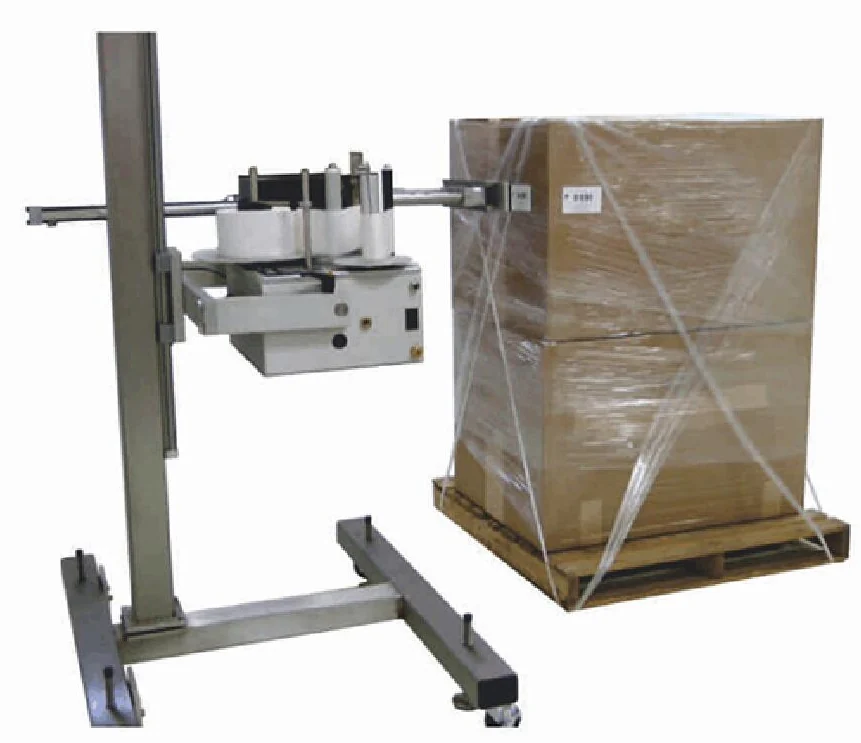
Configured around your label, pack format, line speed and data requirements.
Print SSCC, GS1, destination, batch and logistics labels on demand.
Configure for front, side, adjacent side or pallet-face labelling depending on warehouse requirements.
Apply labels across two faces for tamper evidence, scan visibility or product identification.
Mount alongside powered conveyors or pallet handling stations with sensors and controls.
Designed for packaging halls, warehouses and distribution environments.
Operator interface for templates, job selection, diagnostics and production reporting where specified.
Final specification depends on label stock, print format, throughput and integration requirements.
| System format | Pallet/case printer-applicator with stand, frame or conveyor-mounted structure. |
|---|---|
| Label application | One-side, two-side, three-side or corner-wrap configuration subject to pack handling. |
| Controls | HMI, sensors, print engine controls and line interface to suit the project. |
| Utilities | Electrical supply and compressed air requirements confirmed at quotation stage. |
| Integration | Optional barcode scanner, database, PLC or ERP connection depending on workflow. |
Use print and apply labelling where variable data, barcode quality and consistent placement are required.
Carton and pallet identification for warehouse movement and dispatch.
Outer-case and pallet labels for batch, product and date traceability.
Price, product ID and destination labels for distribution centres.
A typical Lancing print and apply project can include the machine, controls, sensors and integration support needed to fit the system into your process.
Send the details below and Lancing UK can advise on the best format.
Share your label size, pack size, apply face, data source and target speed for a practical configuration review.
Pallet labelling combines long applicator reach with variable loads and logistics data. The specification should define the mechanical envelope and the data sequence at the same level of detail.
Measure minimum and maximum face positions, pallet stopping tolerance, load overhang, wrap condition and the clearance required for the applicator to move and return safely.
Agree the target area on each required face and check scan access after the pallet passes into its real warehouse or dispatch route. Separate-face and corner-wrap formats should be treated as different methods.
Define how a pallet ID is matched to SSCC or destination data, how that match is confirmed and how a pallet is contained if printing, application or verification fails.
A trial should include the extremes that affect reach, adhesion and scan reliability—not only a square demonstration load.
Agree where pallet identity is created, when data becomes final, which controller authorises labelling and which system records success or failure. A scanner result without a defined data comparison or containment action is not a complete verification concept.
The required faces depend on the handling route and scanner access. Confirm where the pallet can stop, which faces remain accessible and how the logistics process expects to scan the label.
Use the maximum and minimum pallet face position, load variation, stopping tolerance, label placement and safe clearance. Reach should be proven on representative loads.
The controls concept should define whether the pallet stops, is quarantined, is relabelled under controlled conditions or is rejected from the normal flow.
It can where the data source, pallet identity, message timing, acknowledgement and recovery behaviour are defined and tested.
Use representative minimum and maximum heights, overhang, stretch wrap, uneven faces and any surface conditions that can affect label adhesion or scan access.
Not necessarily. Two separate face labels and one label wrapped around a corner are different application methods and need different handling and verification.
A pallet labelling station normally sits near a point where the load is complete and its logistics identity becomes final. The controls concept should preserve that identity through stopping, face selection, printing, application, verification and any later rework.
Define the event that confirms which products and quantities belong to the pallet. Record the key used to request or create the label data and prevent a later load change from leaving an obsolete label on the pallet.
Confirm where the pallet stops, how overhang and stretch wrap change the face position, which faces remain accessible and whether separate labels or a corner-wrap method are required. The applicator must complete its motion with safe clearance at the worst normal position.
Where a scan check is required, inspect the applied label on the finished load rather than only reading a loose print. Include wrap glare, wrinkles, straps, uneven faces and the scanner approach used later in the warehouse.
A damaged or failed label needs an authorised recovery route. Keep the pallet identity known, record whether the previous label remains present and prevent two different valid identifiers being left on the same load.
Unlike a small carton, a pallet may not be easy to remove automatically. The project should therefore decide whether each failure stops the station, holds the pallet, diverts it or invokes a controlled manual process.
| No final data | Hold the pallet before printing and retain the identity key needed to retry safely. |
|---|---|
| Printer or media fault | Stop the application sequence, preserve pallet position and prevent an old prepared label being used after recovery. |
| Application fault | Identify whether a label is missing, partial or still attached to the pad before a reprint is authorised. |
| No-read or mismatch | Contain the pallet and distinguish unreadable data from readable but unexpected data. |
| Damaged label after release | Use a relabelling procedure that confirms the original identity and removes or invalidates conflicting labels. |
Use representative loads rather than one clean demonstration pallet. Include the smallest and largest normal heights, overhang, recessed faces, wrap seams and any product or pallet condition that changes application distance.
Yes when the stretch film is stable, the label position is accessible and the selected adhesive makes reliable contact under the real temperature and storage conditions. Loose film, wrinkles and overhang should be included in the trial.
The system may use fixed positions, recipes, measurement or additional applicator travel. The minimum and maximum normal label heights and the scanner field of view should be defined together.
The number of faces depends on the receiving, storage and scanning process. Multi-side application improves access from different approaches but adds motion, cycle time and recovery decisions.
The project should define one authoritative source and keep the SSCC linked to the physical logistic unit through printing, application and any rework. GS1 UK describes the SSCC as the identifier for individual logistic units.
Keep the pallet identity controlled, determine whether a valid label is already present and use an authorised reprint or relabel procedure. Do not create a second SSCC label without reconciling the original state.
Label size, reach, number of faces, guarding, pallet handling, warehouse data, inspection and environmental protection can all change the project.
Pallet labelling depends on more than reach and apply faces. The label construction must survive the logistics route, and any retrofit must control pallet position, data ownership, guarding and rework.
The applicator determines where the label is placed. The warehouse or production data defines which pallet it identifies. Keep those responsibilities connected when a mixed pallet is completed, moved, split or reworked.
Labels used to identify the same unchanged logistics unit should refer to its same controlled SSCC. Two application faces do not create two different pallets. Check any additional transport labels and receiver requirements without allowing conflicting unit identities.
Hold the affected unit while the authorised system reconciles its contents and identity under the applicable rules. Do not dispatch solely because the barcode still scans. Rebuilding, splitting and damaged-label replacement need distinct recovery decisions tied to the physical unit.
Use the SSCC and ASN matching guide to define the data hand-off and the sample-trial guide to record exception evidence.