GS1 and SSCC pallet labels

GS1 and SSCC labels are often the reason a pallet labelling project starts. The machine needs to print accurate data and place the label where it can be scanned reliably.

Guides

What this page helps you decide

GS1 and SSCC labels are often the reason a pallet labelling project starts. The machine needs to print accurate data and place the label where it can be scanned reliably.

  • Clarify the label, barcode and data requirement before machine selection.
  • Choose the right applicator style for the pack movement and apply face.
  • Prepare better information for quotation, integration and installation.
GS1 and SSCC pallet labels

Specification points

These are the areas that usually decide whether a print and apply labeller runs smoothly on the line.

Separate the label rules from the machine rules

  • The label format is normally defined by a retailer, warehouse, customer or GS1 specification.
  • The machine specification defines how that label is printed, applied and confirmed on the line.
  • Treat the artwork, data source and application method as one connected process.

Placement affects scan success

  • Agree the label face and height with the team that scans pallets downstream.
  • Avoid placing labels where stretch wrap, straps, corners or pallet damage will obscure the barcode.
  • Two-side labelling can reduce rework where pallets are stored or loaded in different orientations.

Questions to answer before ordering

  • Who generates the SSCC and when is it available to the printer?
  • Does the line need a scanner to confirm the printed barcode?
  • What happens if the wrong label prints or a label is not applied?

Questions buyers ask

Quick answers for planning the right labelling configuration.

Can a print and apply machine print SSCC labels?

Yes, it can print SSCC labels if the SSCC data and label template are supplied to the printer.

Is two-side pallet labelling better?

It can be better for scan access, especially where pallet orientation changes in the warehouse.

Do I need barcode verification?

Verification or scan confirmation is worth considering where dispatch accuracy or customer compliance is critical.

Need this matched to a real line?

Send label size, pack dimensions, apply position, line speed and data source. Lancing UK can help specify a practical print and apply format.

Data governance

Keep SSCC creation, label printing and pallet identity in one controlled sequence

Define which system creates the identifier, when it becomes final, how the pallet is associated with it and how success is acknowledged. Recovery after a damaged or failed label must not create uncontrolled duplicates.

Design and scan review

Use approved label artwork and confirm the intended symbol, data fields, quiet zones, print contrast, placement and scanner access on the finished pallet. Any formal grading requirement needs its standard and test geometry stated.

SSCC lifecycle

Control allocation, printing, application and rework as one pallet record

The label format may be prescribed by a customer or GS1 process, but the line still needs a clear operational sequence. Define when the pallet identity becomes final, how the record reaches the printer-applicator and how an exception is resolved without leaving conflicting labels.

Allocate and associate

Identify the system that creates or supplies the SSCC and the event that associates it with the completed pallet. The physical pallet should remain traceable to that record through any stop, queue or retry before labelling.

Print and apply

Use the approved label template and confirmed data mapping. Define the required face, height and number of labels from the receiving and scanning process, then prove the application on representative wrapped loads.

Verify and acknowledge

State whether success means label presence, a readable barcode, a decoded value matching the expected SSCC or another documented requirement. Return the result to the system that controls pallet release.

Contain a failure

Keep the pallet in a known position when data, print, application or inspection fails. The operator needs a clear route to identify the pallet and decide whether the original label is absent, damaged or still valid.

Authorise a reprint

Link every reprint to the same confirmed pallet identity unless the business process explicitly replaces it. Prevent unattended retries from producing multiple valid labels after a jam or communications recovery.

Record the disposition

Where the process requires an audit record, retain the expected identifier, print/application result, inspection outcome and the authorised action taken on any failed pallet.
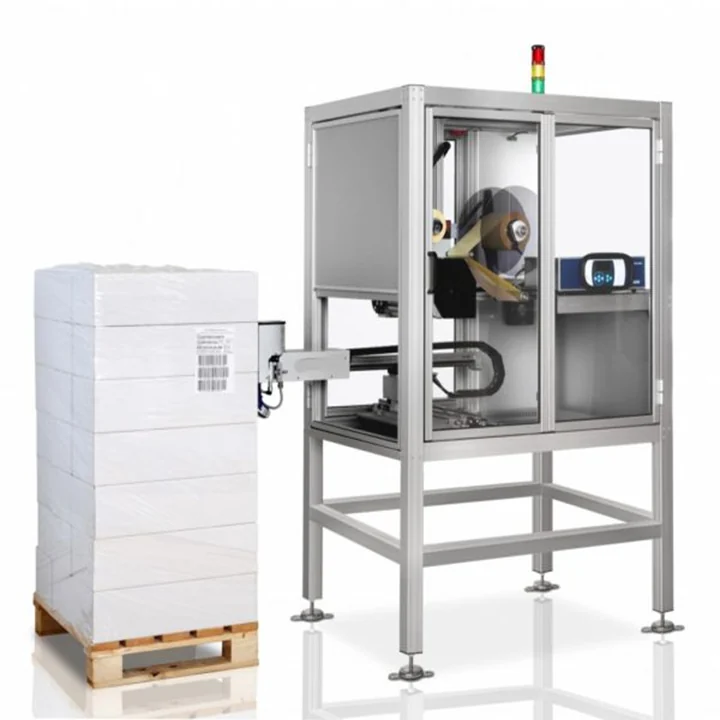
Test the normal path and the relabelling path

A good pallet label on a clean load proves only the normal case. Include conditions that challenge identity control and scanner access.

Normal palletCorrect record, approved template, required face and successful release.
Delayed recordPallet remains identified and cannot receive a previous or default label.
Printer or application faultPrepared label state is known before a retry is allowed.
No-readPallet is contained and the cause can be separated from a data mismatch.
Damaged labelRelabelling procedure confirms the pallet identity and removes or invalidates conflicting information.
Restart after interruptionQueued pallets and prepared labels remain correctly paired.

Keep machine and data ownership distinct

This guide addresses how the printer-applicator handles the assigned pallet identity. The customer’s approved GS1/customer label specification remains the authority for required fields, symbol construction and placement rules.

Extend the SSCC test to the electronic despatch message

The existing SSCC checks establish the label and pallet identity. Extend the acceptance record to show that the despatch advice refers to that same unit and the actual contents released. Test a contents change and a failed message acknowledgement as well as an unreadable label.

The SSCC and ASN data-matching guide provides a responsibility map and exception sequence. The barcode-format guide distinguishes identity, encoded syntax and receiving-system support.

Call nowContact us