Data and software boundary
State which system owns the order, service, address, barcode and label artwork. Define timeout, missing-data and communications-failure behaviour. A printer-ready file is not the same as a confirmed applied label.
Tie each physical parcel to the correct live shipping record, apply the label in a controlled position and contain every failed or ambiguous result.
A shipping-label print-and-apply station identifies the carton or parcel, receives the approved label data, prints the carrier or destination label and applies it in a defined position. The line then confirms the agreed result before the parcel is released. The critical design task is maintaining identity through stops, mixed pack sizes, late data and rework.
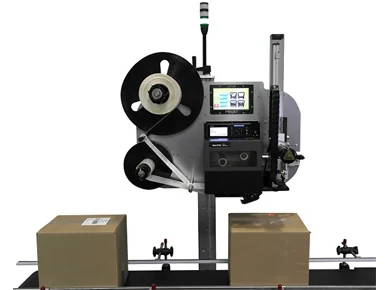
The exact systems and ownership vary, but a controlled shipping-label process normally follows this logic.
A scanner, order record or line-control event establishes which physical parcel is at the labelling station. If weight or dimensions affect the service or label, those values must be final before the label is requested.
The WMS, carrier platform, database or other approved system supplies the correct shipping record and label template. Mandatory data should be validated before printing starts.
The print engine produces the label and the applicator places it on the defined face. Product guidance, height variation, label size and applicator travel must all fit within the available product gap.
The required check may include cycle completion, label presence, barcode decoding or comparison with the expected parcel record. The result must arrive while the affected parcel can still be stopped or contained.
Define which system confirms dispatch and how failed labels, no-reads, duplicate records and manual rework are reconciled. The machine should not assume that a printed label was successfully applied and shipped.
| Pack envelope | Minimum and maximum length, width and height determine sensing, guidance, applicator reach and label position. |
|---|---|
| Surface | Corrugated board, coated cartons, film, bags and reused packs need different adhesion and presentation trials. |
| Orientation | The parcel must present the selected face consistently or the system needs a strategy for variable faces and heights. |
| Product gap | The available time must include data, printing, label presentation, applicator motion and any inspection response. |
| Label position | Keep the label away from edges, seams, tape, straps and unstable surfaces while maintaining scanner and operator access. |
| Downstream handling | Conveyors, sorters, chutes, accumulation and palletisation can obscure or damage a poorly chosen label position. |
State which system owns the order, service, address, barcode and label artwork. Define timeout, missing-data and communications-failure behaviour. A printer-ready file is not the same as a confirmed applied label.
Decide whether the project needs only label presence, barcode decoding, expected-data comparison or formal barcode quality verification. Each check answers a different question and needs a defined failed-parcel route.
Authorised rework should identify the parcel, retire or account for the previous label state, request the correct record and prevent duplicate release. Manual reprints outside the controlled sequence create avoidable traceability risk.
Dimensions, weight range where relevant, materials, photographs and worst normal presentation.
Final artwork, barcode types, label dimensions, data source, trigger and when the record becomes final.
Conveyor height, speed, minimum gap, orientation, downstream equipment and a running video.
Required checks, stop/reject/quarantine route, reprint authority and dispatch confirmation boundary.
It can be possible when the complete size and surface matrix is known and the applicator can reach the selected face within the available gap. Mixed heights may require recipes, automatic adjustment or a different presentation strategy.
Only when weight is part of the shipping decision or label data and is not already final upstream. The project should define where the accepted weight comes from and which system owns the result.
Potentially, but the surface must be presented flat and stable enough for the chosen applicator and adhesive. Wrinkles, trapped air, movement and low-energy films should be tested with representative packs.
The line should fail in a controlled state rather than print an old or incomplete label. Define timeouts, operator messages, parcel containment and the authorised recovery sequence before live operation.
Send parcel samples, label artwork, data ownership, line video and exception requirements so Lancing can review the complete application boundary.