Manual adjustment
Suitable when changeovers are infrequent, settings are accessible and a controlled procedure can prove the active format. Record guide, sensor, applicator and label settings rather than relying on operator memory.
One labeller can often handle several controlled case formats when every format remains within the mechanical, label and timing envelope of the selected system.
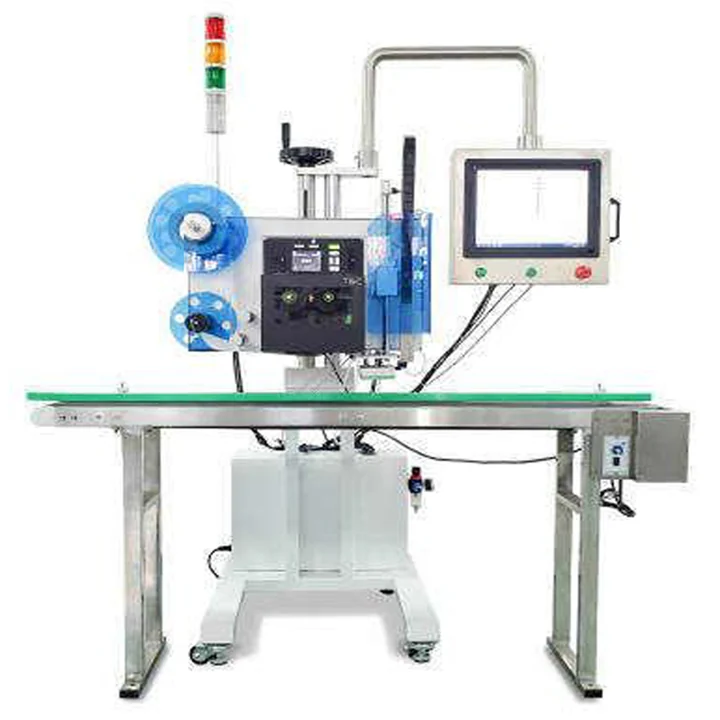
A single print and apply labeller can handle mixed case sizes if each product has a known label, application face, datum, travel distance, sensor strategy and data-selection rule. The key question is not the number of SKUs but whether the smallest, largest and most difficult formats can be presented consistently without exceeding the applicator or line timing envelope.
| Pack dimensions | Minimum and maximum length, width and height, plus normal tolerance and bowed or damaged conditions. |
|---|---|
| Label | Dimensions, orientation, print method, artwork, variable fields and whether different formats use different stock. |
| Application face | Top, side, front, corner or pallet face, with datum dimensions and allowed placement tolerance. |
| Presentation | Guide position, sensor target, conveyor speed, product gap, orientation and stability. |
| Applicator setting | Travel distance, pad or wipe geometry, dwell, return and any height or width adjustment. |
| Data and recipe | How the active product is identified, which template is loaded and how incorrect selection is prevented. |
| Verification | Expected-data record, scanner position and failed-pack response for each format. |
Suitable when changeovers are infrequent, settings are accessible and a controlled procedure can prove the active format. Record guide, sensor, applicator and label settings rather than relying on operator memory.
Stores product-specific timing, travel and template selection. Recipes reduce repeated entry but still need controlled approval and a physical check that guides and product presentation match the selected job.
Can support mixed sequences when a scanner, upstream system or measurement device identifies each pack reliably. The interface must define unknown products, contradictory data and the safe response to failed detection.
No, but changing label stock can require a roll change, media-path adjustment, pad change or separate print engine. A common stock can simplify production, while multiple stocks should be included in the changeover and mistake-proofing plan.
Yes, if the system receives the correct record in sequence and the pack remains identified through printing and application. Mixed data increases the importance of queue control, expected-data comparison and restart procedures.
The solution may use a longer applicator travel, recipe positions, automatic measurement or a different application face. The furthest and nearest normal surfaces must both be trialled with the smallest product gap.
They can if mechanical adjustments, template changes, label-stock changes or product identification add time. The required production sequence—not only steady running of one format—should be included in the output assessment.
Often they do when the label datum or sensor target changes. Use marked positions, scales, recipe-controlled actuators or automatic adjustment where justified, and include a verification check after changeover.
Separate stations may be preferable when formats require incompatible label stocks, opposite application faces, very different cycle times or independent production flows. A format matrix and line-layout review should make that trade-off explicit.
List each pack size, label, position, data source, speed and changeover requirement so one-machine suitability can be assessed properly.